
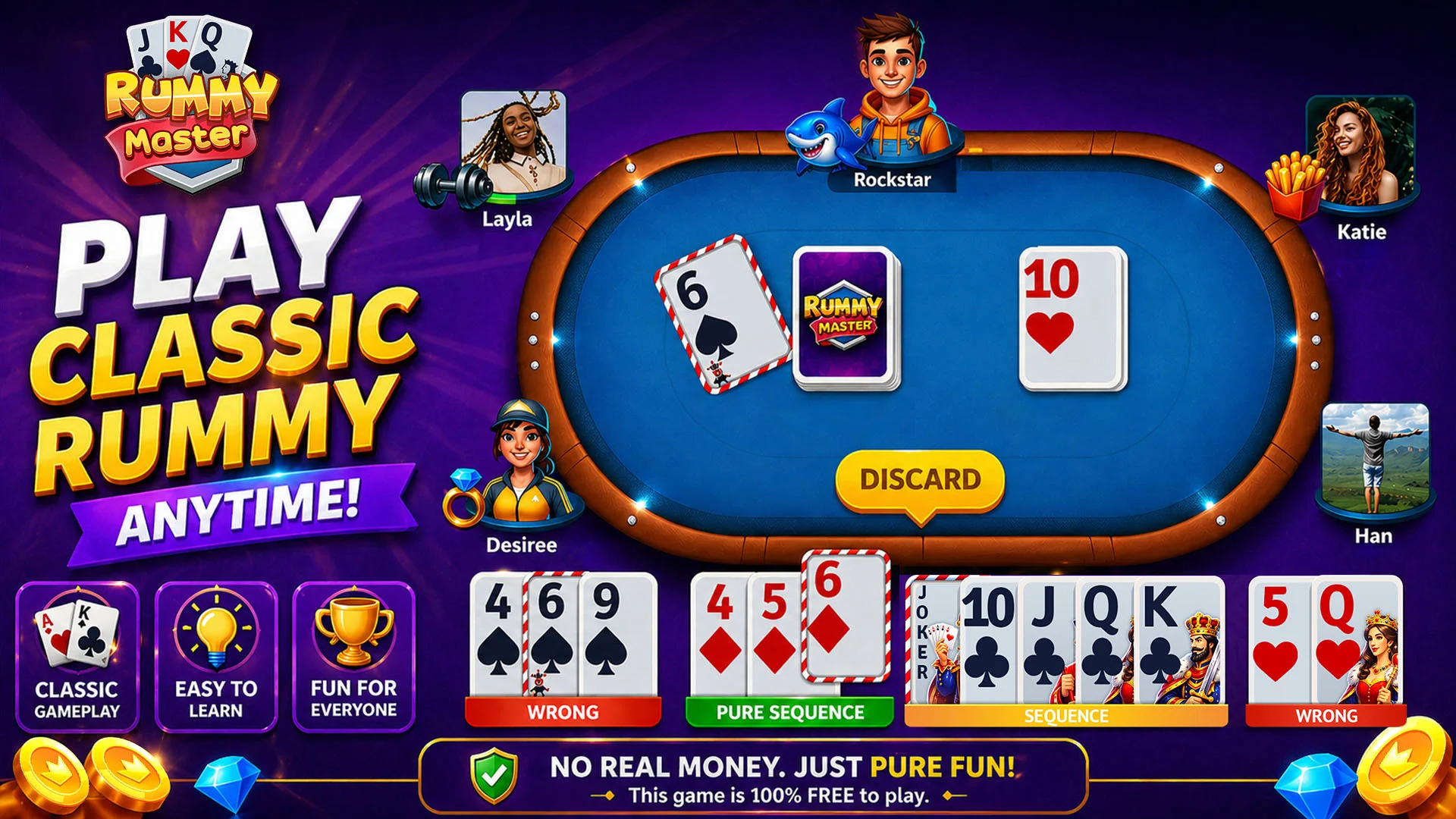
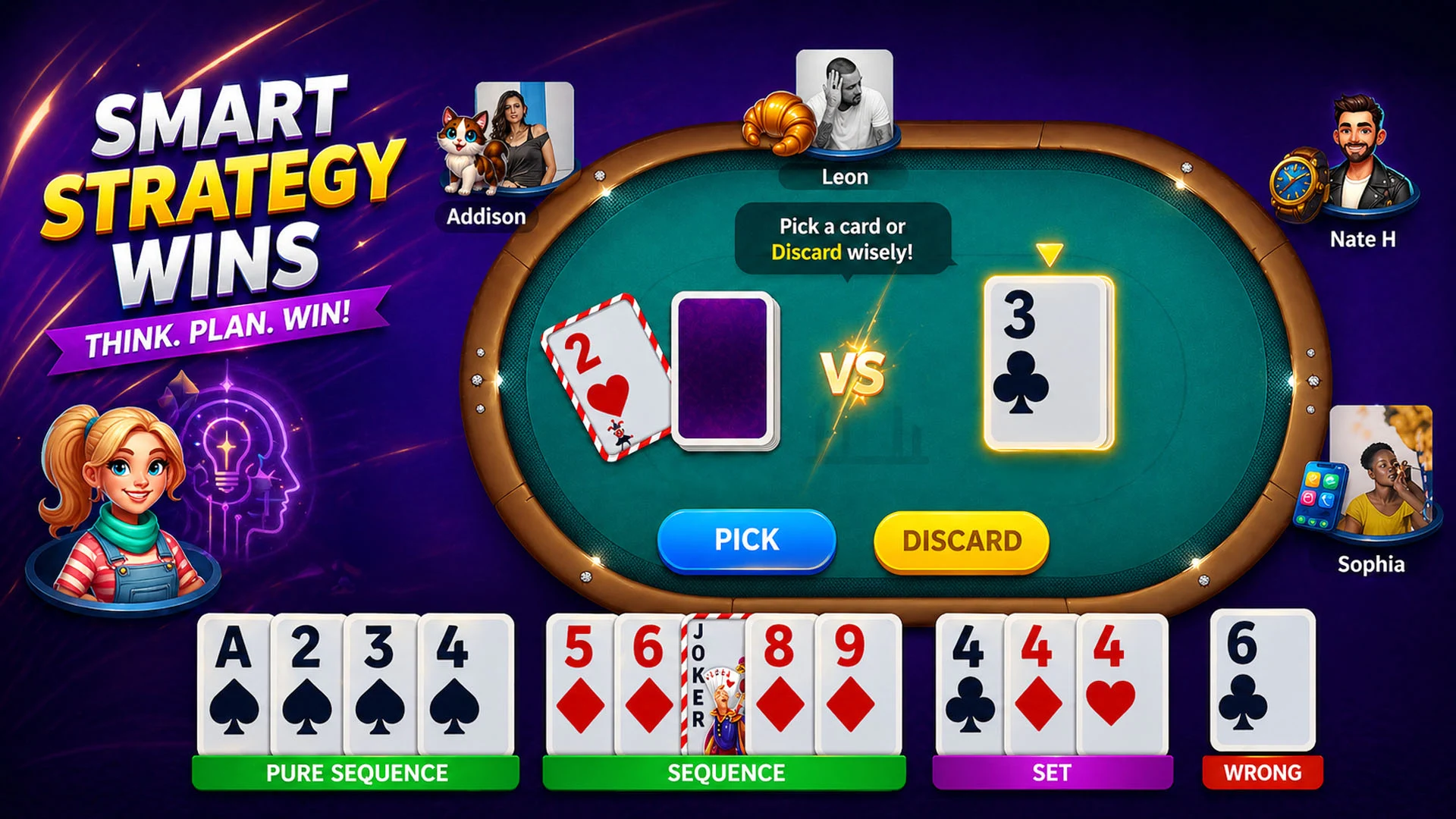
In the game
Table views so you know what Indian Rummy looks like before you install.
Quick facts
- Players
- 2–6
- Cards / setup
- 13 per player
- Goal
- Valid declare with ≥1 pure sequence
- Common formats
- Points · Pool · Deals
- Best for
- Players who like planning sequences
- Welcome offer
- ~₹52 after signup (confirm the live amount in the app)
How to play
- Join a Points, Pool, or Deals table and wait for the deal.
- Each player receives 13 cards from the shared decks.
- On your turn, draw from the closed deck or the open discard pile.
- Discard one card to end your turn.
- Build at least one pure sequence (same suit, consecutive, no joker).
- Finish the rest of your hand as sequences and sets.
- Declare only when every group is legal under the table rules.
- If someone else declares first, unmatched cards become penalty points.
Example
Sample idea: you hold 5♥ 6♥ 7♥ (pure sequence), 9♠ 9♦ 9♣ (set), and 2♣ 3♣ Joker (impure sequence). After the remaining cards are grouped legally, you can declare. If you still hold a lone King, that King becomes deadwood if someone else declares first.
Rules & scoring
A pure sequence is three or more consecutive same-suit cards with no joker.
An impure sequence may use a joker. A set is three or four of the same rank in different suits.
Printed and wild jokers follow the table sheet — they help impure groups, not a pure sequence.
Unmatched cards add penalty points when another player declares. Face cards and Aces usually cost more.
First drop / middle drop penalties are table-specific; read the room sheet before you drop.
Key terms
- Pure sequence
- Consecutive same-suit cards with no joker.
- Impure sequence
- A run that uses a joker as a substitute.
- Set
- Same rank, different suits (usually three or four cards).
- Declare
- Show a finished valid hand to end the deal.
- Drop
- Leave the hand early for a fixed penalty.
Variants in the app
These table names appear in Win Rummy lobbies and can change with updates. Always read the room sheet before you sit.
- PointsSettles every hand. Winner takes points from the others, then the next deal starts. Best while you learn declare risk.
- Pool 101 / 201Points stack across deals. Hit the pool limit and you are out. Last player under the limit wins the pool.
- DealsA fixed number of deals (often 2 or 3). Chips move each hand; highest chips after the last deal win.
How it compares
Compared with Teen Patti, Indian Rummy is about building groups over many turns, not a three-card showdown. Compared with Marriage Rummy, this page is the classic 13-card deal.
Tips & common mistakes
Do
- Lock a pure sequence early before you chase fancy sets.
- Track high deadwood that hurts if someone else declares.
- Start on Points tables while you learn.
Don’t
- Do not declare without checking every group twice.
- Do not hold four high deadwood cards hoping for a miracle draw.
- Do not ignore the drop cost when your hand is clearly stuck.
Payments & withdrawals
UPI channels supported in the cashier for deposit and withdrawal. What you see can vary by amount and account status.
 Paytm
 PhonePe
 Google Pay
 Other UPI
Welcome rupees
After you register, many new accounts see about ₹52 before their first Indian Rummy Points table. The exact banner in the app is what counts if the offer moved.
Download & install
Get Latest (v2.4.1, ~48 MB) from Telegram, then open Indian Rummy in the lobby. Use Previous (v2.3.0) only if Latest will not install.
After you install and register, open Indian Rummy inside the Win Rummy app.
FAQ
What is a pure sequence?
Three or more consecutive same-suit cards with no joker. You need at least one before a valid declare.
Points, Pool, or Deals — which first?
Most beginners start with Points. Pool and Deals keep a longer session score.
How many players?
Usually 2–6 at online tables.
What happens if I declare with a wrong group?
Invalid declares usually attract a penalty. Check every sequence and set twice before you tap declare.
Where do Points / Pool / Deals differ?
Points settle each hand. Pool stacks toward a limit. Deals play a fixed number of hands. See our compare page for a side-by-side.
Updated 2026-10-13